‘Will Their Past Become their Future?’A Speculative Study of the Indo-Chinese Conflict from 1962-2023
Abstract/ Overview
China and India have clashed more than they have cooperated. The most painful thorn on both sides is the poorly drawn 3440km Line of Actual Control (LAC) between the two countries. The many lakes, rivers and snow caps in this area contribute to a blurry and shifting demarcation of the LAC. This paired with contrasting leadership ideologies and foreign policies, diplomatic failures, and insufficient economic ties caused one of the most brutal clashes on the roof of the world in 1962. Although political, economic, and social circumstances have changed on both sides of the border since then, the potential for armed conflict has remained present. This paper attempts to evaluate the likelihood of renewed war between these Asian giants. It does so by comparing, and contrasting their leadership ideologies, foreign policies, diplomatic channels, economic ties, nuclear deterrence, and the Tibet issue in 1962 with the present. India and China are the fastest emerging economies in the world today and a war between them could quickly change the dynamics of the geopolitical order and multilateral relationships. By comparing their past to the present, we can better grasp the potential for new conflict and hopefully work to avoid it.
I. A War on the Roof of the World
The Indo-China War of 1962, also known as the Sino-Indian War, was a conflict between the Republic of India and the People's Republic of China. The war was primarily fought over a border dispute between the two nations in the Himalayan region. As with many other struggles of former colonies, this issue can also be traced back to the partition of India in 1947 which happened at the end of World War II and the beginning of Cold War. The geo-politics of the world was undergoing massive transformations and towards the end, the colonizers were being forced to leave. Their departure is majorly attributed to two factors: the increasing armed revolts in India[1] and the depleted state of their economy after World War- II. As the colonial masters marched away, they left behind a legacy of border disputes in the Indian subcontinent where India, Pakistan, and China converged.
The McMahon Line was drawn by British to serve as the boundary between British India and Tibet. China initially did not object to this line. It was in the later part of 1940s that China outrightly rejected the validity of this border and started claiming sovereignty of several points between the tiny Himalayan states of Nepal, Bhutan, and Sikkim. Moreover, due to its distance and isolation, Aksai Chin had been a long-ignored region of the subcontinent. Things changed when the Chinese sought to unite Tibet and Xinjiang by constructing a military route across the region. India opposed China's occupation of the area, which it said was part of the Ladakh region administered by India.
Prior to the infamous war of 1962, many smaller skirmishes had occurred in the region and were mostly a result of Tibet uprising against the PLA troops in the region. India granted asylum to Dalai Lama in 1959 and that sealed the fate in favor of an armed conflict. On October 20, 1962, the PLA troops attacked the disputed areas with full force. India was caught unprepared. The war lasted less than a month and culminated in India’s humiliating defeat. 7000 Indian army men were killed or taken prisoners, and the lands of Assam lay wide open[2].
Contrasting leadership ideologies and foreign policies, incompetent diplomacy, and weak economic ties, all came together to cause the catastrophe of 1962. The disagreements over the 3440km border between India and China (Line of Actual Control) continue to date. Over the years, China has disregarded the McMahon line several times and asserted its claim on large parts of the
Indian state of Arunachal Pradesh, often calling it "South Tibet”. India maintains that the border should be the McMahon Line as drawn by British.
II. Argument
The old ways have become a page in history, but the conflict has stayed alive and unresolved. Border skirmishes in Galwan and Siachen areas on the border, have continued as recently as 2022. To understand the future possibilities of an armed conflict between India and China, it is prudent to look at what caused it in past. What follows is an analysis of the original causes of war in 1962 compared with similar or dissimilar alignment of the same factors in the present day.
The findings of this paper indicate that is unlikely for India and China to engage in a fullblown armed conflict in the near future, at least. That said, it is important to recognize some ‘disruptors’ in their equation which can dissolve the status quo and act as triggers and pave way for some sort of a conflict once again.
Focusing the assessment on leadership ideologies, foreign policies, effectiveness of diplomacy channels, their economic ties, nuclear deterrence, and the evolution of the Tibet issue,
I present a ‘Tipping Scales’ model to examine the relationship of India and China:
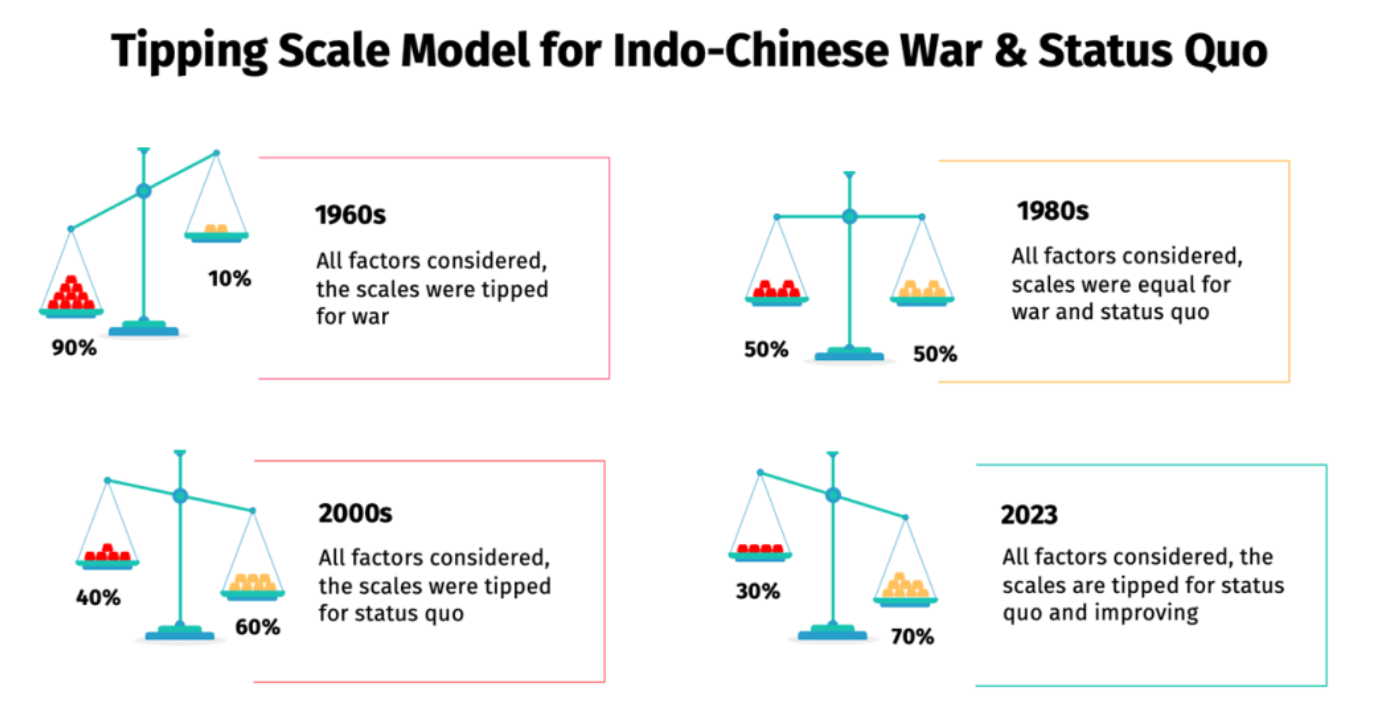
Fig. 1
The yellow cubes in the model (fig 1) denote the positive confluence of the five factors: compatibility of leadership, effective use of diplomatic channels, aligned (or non-competing) foreign policies, improving economic ties and careful handling of the Tibet issue. The red cubes denote the
“disruptors” such as: the use of war hysteria by the leadership as a tool to consolidate power, failed diplomacy concerning the increasing Chinese infrastructure development along the LAC, competition replacing cooperation, nuclear threats, and reckless handling of the Tibet issue. The red cubes are weighted more than the yellow cubes, meaning a smaller number of “disrupting factors” can outweigh a greater number of positive factors in tipping the scales towards war.
India and China have captured the world's attention for two contradictory reasons: a) their economic rise, which allows them to change the world's power structure by collaborating with one another, and b) the instability they can cause in the Asian subcontinent due to their ongoing border conflict with one another.
Numerous minor occurrences need to fall in place for any major event to happen. The Sino-Indian war of 1962 was one such event. It was an ugly outcome of several faulty leadership decisions taken on both sides of the border. This paired with Indian ignorance of Chinese foreign policy stance, inept diplomacy, and weak economic relations made the war a reality. Fortunately, many of these mistakes have been realized and repairs have been attempted. As a result, the bilateral relations of these countries have seen some improvement.
As the new India struggles to break away from the "spell"[3] of Nehruvian socialism, China is torn between whether to trade or invade, and whether to collaborate or compete. While the original issue stands unresolved, the present-day dynamic of Indo-China relations is headed down a promising road. Their growth-oriented leadership calculated foreign policies, and reviving trust in diplomatic channels, all point to the unlikely scenario of an all-out war in the foreseeable future. The scale seems to be tipping more toward status quo rather than conflict.
The border disputes in Indian subcontinent have been a widely studied topic in international relations, comparative politics, and security studies. In case of India and China, most scholars agree on the poorly drawn 3440km border (Line of Actual Control) as the root cause of the conflict.
Some studies on Indo-China conflict and independent analysis of the two countries suggests that
the issue goes beyond the Line of Actual Control. Yet, barring a few media pieces now and then, there has not been a scholarly revisitation of the factors leading to the 1962 war in depth, to assess the possibility of a similar conflict in future. This paper attempts to fill this gap and reasonably answer the question of whether or not these Asian giants are headed to war.
I propose that the war of 1962 was a confluence of multiple factors such as the contrasting ideologies of leadership, contradictory foreign policies, diplomatic failures, the aggravation of the Tibet issue after Dalai Lama’s asylum in India and weak economic ties. This paper will dissect each of these factors from the perspectives of various scholars to explain why war is unlikely. Considering the fact that India and China are both nuclear powers, this paper will also evaluate the role of nuclear deterrence in avoiding conflict. Furthermore, this paper will analyze the impact of some modern day 'disruptors' that can cause a breakdown of the status quo and pave the way for some kind of conflict.
III. Comparative Historical Analysis of Indo-China Relations: 1962 v. Present To collaborate, or compete; to trade or invade? All countries grapple with these dilemmas at some point. Over the years, Indo-China relations have seen a fair share of conflict and cooperation. When scales were tipped in favor of conflict, the bilateral issues of these countries manifested in the form of a military conflict in 1962.
When the errors of the past are realized and proactively addressed, history does not repeat itself. India and China seemed to the necessary lessons from history. The 1950-60’s were a turbulent time for both countries. While India was recovering from the aftermath of a bloody partition, China was facing the repercussions of GLF reform failures under the newly founded
People’s Republic of China (PRC)[4].
In the years preceding the war, President Radhakrishnan and PM Nehru were actively negotiating the border dispute with China. Disagreements are part of any negotiation, and they were expected in this case too. Indian leadership of the time, however, didn’t expect an armed retaliation by the Chinese, as an expression of their disagreement. India felt betrayed by China and the leaders were greatly criticized for their ‘negligence’[5]. Those who believe India provoked China in 1962, blame
Nehru’s rigidity for standing in the way of border negotiations[6]. Many accounts claim that ‘forward policy’ tipped the scales in favor of the infamous war[7]. Others point out that the Indo-China conflict cannot be assessed by examining any isolated sequence of events or their nature but rather, their greater geopolitical context. Upon careful examination of 1962 war the planning from both sides, there is evidence to show that the Sino-Indian war of 1962 had been coming for a while[8]. China had begun extensive preparations including building infrastructure in Tibet, gathering intelligence, and deploying forces in 1951, at least two and a half years before Nehru’s forward policy decision. In fact, China’s own foreign policy was more aggressive than India’s when PLA troops entered Tibet in 1950 and marched straight for Indian borders9. This is surprising given that in the Simla Conference of 1913-14, the Chinese authorities did not raise any reservations regarding the McMahon Line and had signed off on the mutually agreed maps with India. At the time, they were primarily concerned about the border between China and Tibet which was the main point of contention during the 9 months of negotiations[9]. Why then would the border with India become significant later? Brigadier Dalvi, an Indian army officer and a 1962 war veteran, notes in his memoir of the Sino-Indian war of 1962 that the Chinese justified the decision of war as a ‘reaction’ to India’s new policies and saw war as the only way to bring India back to negotiations[10]. This further evidences that newly independent India exhibited immature diplomacy and foreign policy planning at the time and paid a heavy price for underestimating China.
In 1959, India granted asylum to Dalai Lama and allowed him to establish a government in exile. This acted as a heavy ‘red cube’ and tipped the scales towards war. It is also crucial to understand China’s economic and political state in 1962. China was a hunger-struck nation after the ‘Great Leap Forward’ (GLF) collapsed and led to the largest man-made starvation period in human history. Mao was discredited and, very likely, on his way out. To him, the best way to regain power perhaps seemed an attempt to unify the nation, especially the armed forces against an external enemy such as India.[11]
Even today, Dalai Lama’s presence in India, which the war made de facto irreversible, continues to be a strain on Sino-Indian relations and the embodiment of the unresolved status of the Tibet issue. For Beijing, the Dalai Lama’s government in exile in Dharamsala has been a constant challenge to its rule in Tibet. Meanwhile, for Delhi, it has been a symbol of Beijing’s refusal to grant real autonomy to Tibet. Granting asylum to Dalai Lama has proved to be a doubleedged sword for India. While it has given India a "Tibet card" to use against China, it has also trapped India in a complex situation. Delhi has no control over what the Tibetan leaders says or does against Beijing, and it can also not force the Tibetan leader out of the country due to internal and international repercussions. This has resulted in fueling tensions between India and China further.
IV. The Renewed Need for ‘Asianism’?
The ongoing disagreement over the Line of Actual Control (LAC) with China and the Line of Control (LOC) with Pakistan are examples of British manufactured border disputes and ethnic fragmentation in the Indian Subcontinent. This land, shared between Pakistan, India, China, and Bangladesh has become the blueprint for a myriad of issues ranging from poverty, malnutrition, refugee crises, terrorism, and serious human rights violations.
However, the current geo-political trend indicates that several countries in the East have recognized the importance of regional cooperation. While disagreements still exist, there is more room for dialogue now. For India and China too, much has changed on either side of the border since Nehru and Mao in terms of leadership ideology, foreign policy, diplomacy, and economic ties. Attacks on Indian troops on northeastern border have continued since 1962 but India has resisted the urge to respond with military force. Instead, there have been diligent efforts to bring China back to the negotiating table. China has also begun responding more positively in the last few years.
That said, it is prudent to look back and analyze what has caused the war, what has changed and what is needed to enhance cooperation and avoid conflict.
A. Leadership Ideologies
The 1950-60s were the ages of Nehru and Mao in Asia. There were elements of instability in both countries during this time. India was recovering from the chaos of partition and China, from the failures of the Great Leap Forward. Chin was led by Chariman Mao Zedong, who believed in ideology over economic growth[12]. Meanwhile, Indian Prime Minister Jawaharlal Nehru was an embodiment of the famous traits of India from Gandhian times—peace, non-violence, and tolerance14. In the programmatic nationalism of Indian National Congress, the message of harmony and collaboration in the world was dominant[13]. Nehru envisioned India and China as friendly Asian powers, non-aligned with the west and out of armed engagements. His biggest mistake was assuming China to be a follower of the same vision[14]. It would’ve been a different story, and perhaps one with less bloodshed, if these two leaders formed an alliance or a mutual understanding as Nehru imagined in his ‘Asianism’ utopia in the 1950s. I call it ‘utopia’ in hindsight, not going forward. Considering the lack of awareness on Nehru’s part regarding China’s stance at the time, the idea was unreal (not to say that effective diplomacy couldn’t have changed it).
As India sang hymns of ‘Hindi-Chini Bhai-Bhai’[15], China was preparing to attack the EastIndian borders. In retrospect, this attack can be seen as Mao’s last attempt at regaining power after the failure of GLF reforms. All this while, India remained blissfully unaware of its neighbor’s expansionist ideas. Like China, India was also struggling. But the paths the two leaders took to regain power, were very different. One was on the path of becoming largest democracy of the world and the other, one of the most resilient authoritarian regimes.
In the aftermath of the partition, reducing poverty and preventing the economy from total collapse was Nehru’s primary focus. As a result, scarce attention was given to army resources and border preparedness in India. The Chinese army on the other hand was being trained and equipped o expand its territory or ‘regain’ it in the language of the Chinese. As a result, two things were inevitable—the war and India’s defeat.
Today, Nehru’s India and Mao’s China have evolved in many aspects, especially in terms of strengthening state capacities as well as their bilateral relations. Currently, Prime Minister
Modi’s focus is on making Indian economy self-reliant. Meanwhile, President Xi is consolidating power and tightening his grip at home. Furthermore, in a sharp contrast to the 1950s-60s, the leaders of both countries have even attempted to put forth a united Asian front against the West. This situation as it is now, seems far from war.
The only disruptors of status quo here could be the leadership’s use of war, on either side to strengthen their political control. In India, war with unpopular neighbors is a well-known harbinger of votes for the ruling party. In 2019, 44 soldiers of the Indian Central Reserve Police Force (CRPF) were killed in a terror attack by a separatist in Pulwama region of Kashmir. Modi government gave emotional statements like “our blood is boiling” and “India will not be quiet” and launched multiple surgical strikes into terror camps at Pakistan. In the elections that followed, BJP won the elections with overwhelming majority18. China is the burning topic in Indian poltics at the moment and currently, the Modi led BJP government is losing state elections to Congress. The continuation of this trend leading up to the general elections of 2024 could result in the BJP adopting an aggressive approach towards China in order to regain lost territories and its legitimacy as the rightful ruling party. Similarly, in China too, display of aggression towards India may boost support for President Xi and accelerate his efforts to consolidate power. President Xi can be “unpredictable”[16] in his foreign policy approaches. Therefore, it is not outrageous to assume that he will take a page from Mao’s playbook if push comes to shove.
That said, it is unlikely the nature of this conflict will be an armed military combat considering the difference in state capacities of India and China vs India and Pakistan. For short-term political gains like these, small displays of authority along the border such as building more infrastructure on the contested parts, increasing military troops and weapons, are often enough to convince masses and increase power domestically.
B. Foreign Policies
A worrisome aspect of the Chinese policy in 1962 was that its encroachments were parts of a welldesigned strategy. The Chinese infringements into the Aksai Chin region were also not random.
Rather, they were part of a strategically planned and coordinated “expansionist strategy”. This is something India failed to recognize in the 1950s. The same can be stated about its encroachments in the South China Sea (SCS) and East China Sea (ECS). This presages a more aggressive policy along the Indo-Tibetan border, in the SCS and in the ECS in the third term of Xi Jinping[17].. As India sang the hymns of non-violence in its foreign policies, China prepared for territorial expansion. Even the acquisition of Tibet did not seem to alarm India. Clearly, the power asymmetry was in favor of China and India was forced to defend, unaware and unprepared in the face of conflict.
The 1962 conflict also imbued Sino-Indian ties with a strong feeling of competition, which has influenced both nations' foreign policy. Seeking to balance the other, both countries have developed partnerships that serve as a counterweight to the other. For instance, Beijing's all season camaraderie with Islamabad fuels Delhi's stronger relationship with Moscow. Both sides have also competed for influence in their peripheries, particularly in Burma and Nepal, and have resented the growth of the other's power close to their borders. However, in contrast to 1962, today the Indian state can match China’s capacity to launch an attack in favor of internal security. The surgical strikes on Pakistan terror bases in 201621 are one example of this.
As Chinese infiltrations grew in South Asia, India’s preparedness increased as well. When China’s alleged 'string of pearls' strategy to surround India's maritime frontier started gaining traction, Delhi quickly came up with a counter strategy called the ‘necklace of diamond’. The
‘string of pearls’ is a geopolitical concept referring to China’s efforts under its Belt and Road Initiative. China’s objective here is the establishment of a network of military and commercial facilities along strategic maritime chokepoints in the Indian Ocean. The term ‘string of pearls’ was coined by Booz Allen in 2004[18]. The "pearls" in the string represent various port facilities and military bases that China has either established or secured access to, stretching from the Chinese mainland to the Persian Gulf. These include ports, harbors, and naval bases in countries such as
Pakistan (Gwadar Port), Sri Lanka (Hambantota Port), Bangladesh (Chittagong Port), Myanmar
(Kyaukpyu Port)[19]. The ‘necklace of diamond’ strategy is similar attempt by India to circumvent China by allying with its neighbors. To achieve this, India first established its presence at the chokepoint of the Strait of Malacca. Then it went on to make strategic alliances with China’s neighbors like Mongolia and Japan who also have active border disputes with China. This strategy was first mentioned by India's former Foreign Secretary Lalit Mansingh while addressing 'India's Regional Strategic Priorities' in his speech at a think tank[20]
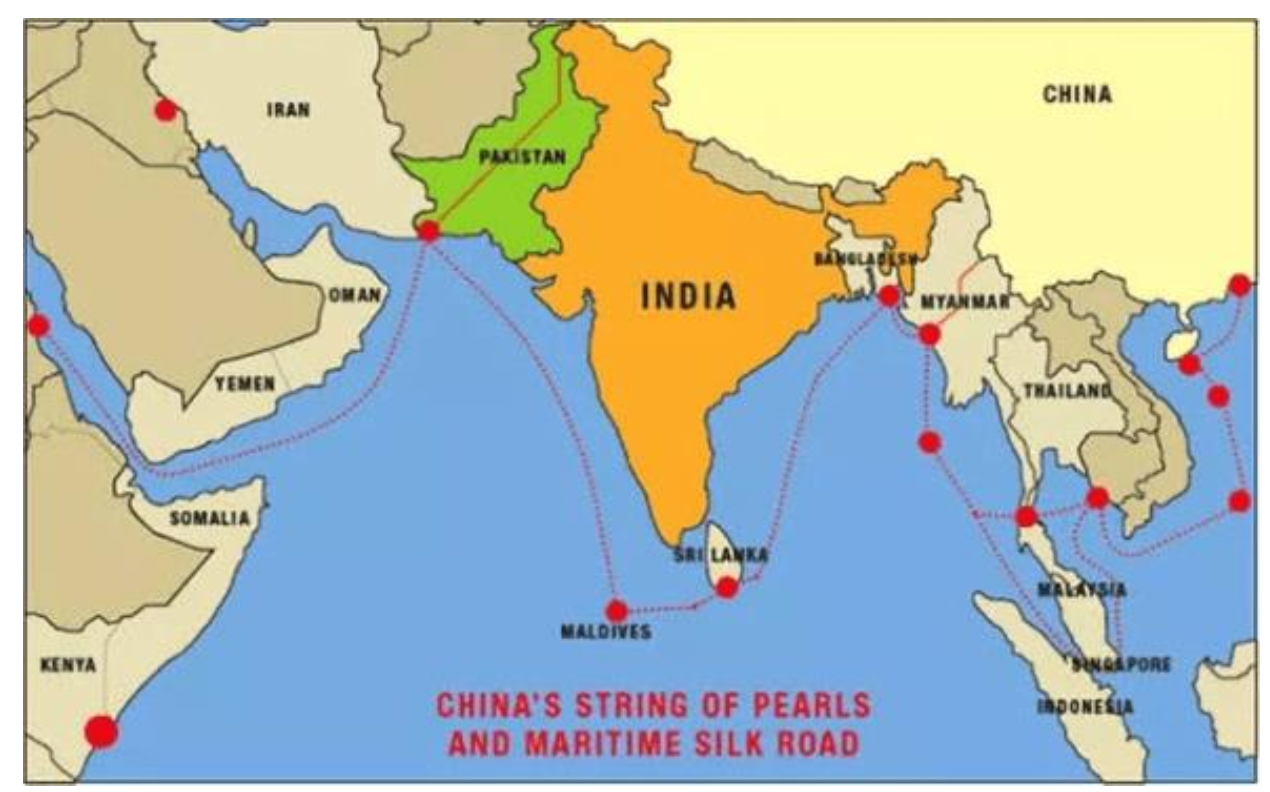
Fig 2: China’s String of Pearls Around India; Source: Forum IAS
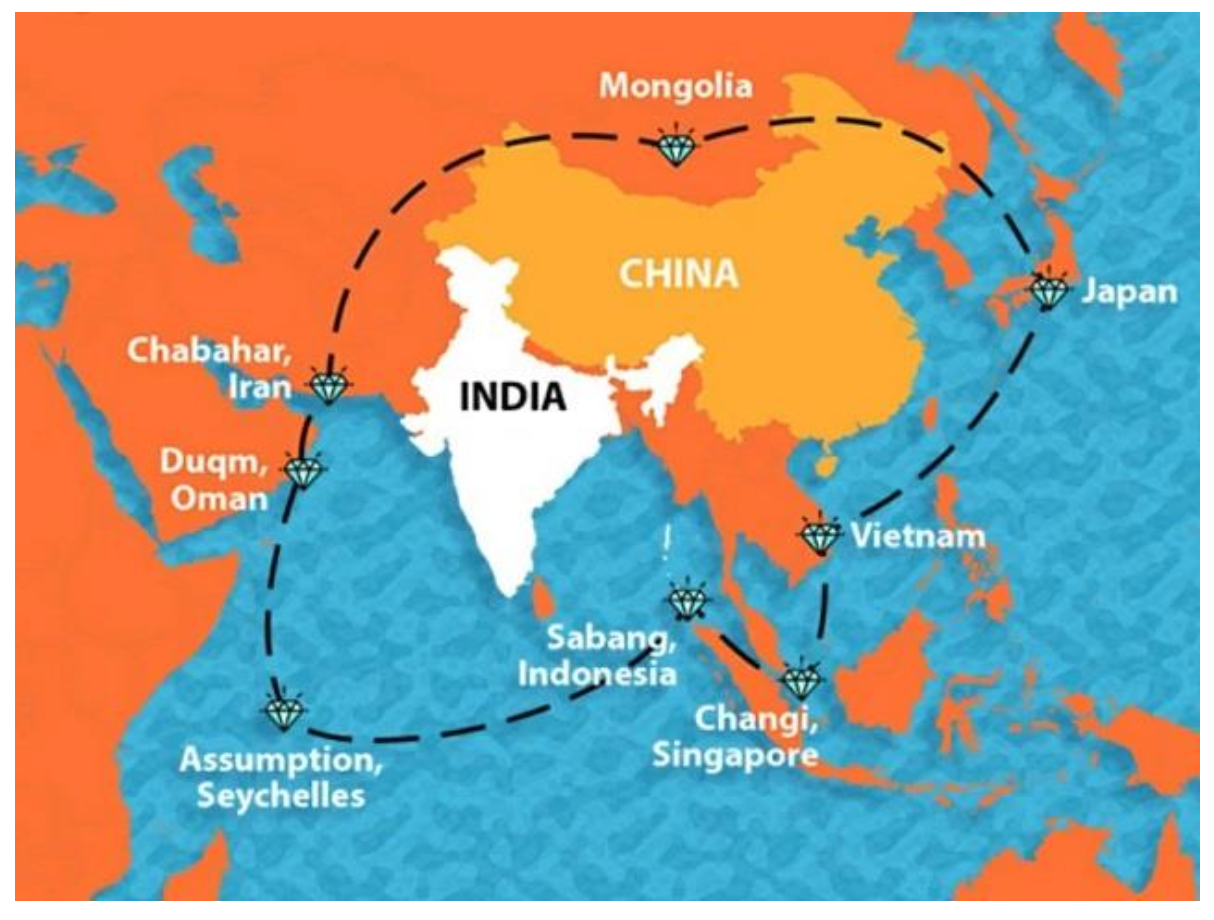
Fig 3: India’s Necklace of Diamond Around China Source: Dainik Jagran
Moreover, PM Modi is prioritizing the implementation of self-reliant policies focusing on more exports instead of imports in India. Meanwhile, China’s foreign policy is also more focused on tackling the issue of Taiwan’s independence, Hong Kong, and challenging US hegemony economically. There is little space for clash between the two here. Sustaining peace seems to be the new trend in Asia exemplified by the China’s active role in brokering a peace treaty between Saudi and Iran in favor of regional cooperation and a united Eastern front against the West. Saudi and Iran have not only signed a peace accord but have also been formally invited to join the BRICS nations (Brazil Russia India China and South Africa). The focus of BRICS nations today is to collectively dethrone the US dollar in global trade practices[21]. These developments are premised on regional cooperation. If two major players of BRICS nations are actively engaged in border disputes amongst themselves, their goal which seems to be the priority at the moment, will be difficult to achieve.
That said, there can be two disruptors of this peaceful coexistence, potentially tipping the scales towards conflict. First is China’s recent development of villages inside the Indian state of
Arunachal Pradesh, bordering China[22]. Internal security always trumps regional cooperation, and this is a serious issue for India, where it can justifiably take an aggressive stance against China. Another disruptor to their improving relationship can be the China- Pakistan alliance. China supporting Pakistan in the Kashmir issue has for long, been a reason for India’s lack of trust in China. Recently, China proposed a $58 Billion railway project under China’s Belt and road
Initiative, connecting Pakistan’s Gwadar port to Kashgar in Xinjiang province of China[23].
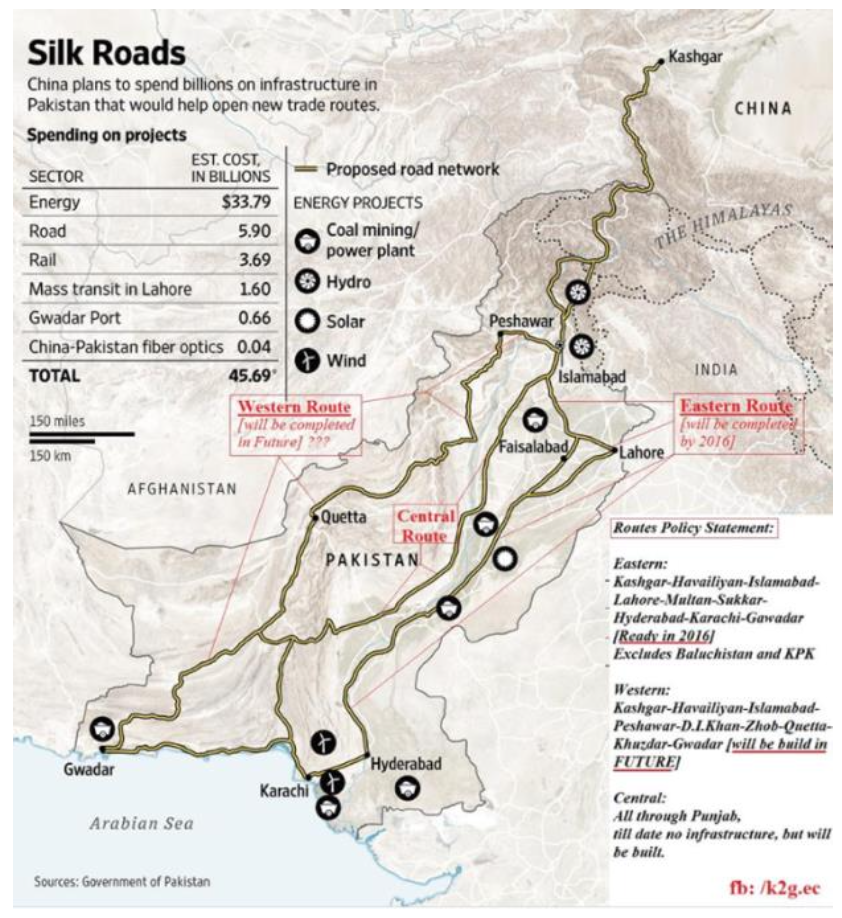
Fig 4. 3000km proposed railway line between Gwadar, Pakistan and Kashgar, China Source: South China Morning Post
The infrastructure itself is not a problem, but what it can be used for and by who, is the concern.
Overall, China’s Belt and Road Initiative is a remarkable manifestation of its foreign policy, leveraging the economic dependence of developing nations to strengthen its hold in the region. While some believe China is being rational in trying to achieve both peaceful co-existence and fulfilling its ‘expansionist’ ambitions through BRI[24], it has potential to affect China’s relationship with India in significant ways. The problem is not so much that China is a threat but that it is deeply insecure which has often led it to supporting Pakistan to help with the ‘India problem’ when needed. Policies of threat, balance, sanction, boycott, and critique are more likely to reinforce insecurity in Chinese leadership. If China continues to supply resources to Pakistan and it leads to another 26/11 or Pulwama on Indian soil, India may not limit its wrath to Pakistan and Indo-China bilateral relations may also undergo turbulence.
At the moment, while their infrastructural strategies confirm the existence of unresolved tensions between the two countries, they also indicate the passive approaches of retaliation in their foreign policies. The dispute may continue but the equalizing power structure between India and China is acting as a strong deterrent to armed conflict. As long as both the countries stay focused on development and Pakistan being aided by China doesn’t raise internal security alarms for India, peaceful coexistence between China and India can be sustained.
C. Diplomatic Channels
War represents a lot of things, but most importantly, it signifies the failure of diplomacy. India’s former Foreign Secretary, Vijay Gokhale penned the journey of India’s diplomacy over 4 decades in his book ‘The Long Game[25]’. He highlights the consequences of India’s “hasty” recognition of People’s Republic of China. India was the first country to recognize PRC to avoid being seen as
‘camp follower’ or ‘lackey of capitalist block’, as the Chinese media had been projecting it. This cost India heavily as it gave China an upper hand in diplomatic negotiations concerning the border dispute. In the early 50s, India’s approach to China lacked pragmatism and failed to advance its national interest. In regard to its special privileges in Tibet, neither was India able to retain them nor to leverage them to settle the border issue. This set stage for future conflicts and culminating in the 1962 war. Furthermore, Nehru’s adamant stance on non-alliance couldn’t have been worsetimed. India refused to ally with the west in the direst of diplomatic times. In fact, when the USA offered India a permanent seat on the United Nations Security Council, India gave it up for China. Today, China is the biggest opponent of India’s admission to the UNSC as a permanent member.
In the years leading up to 1962, China’s diplomatic approach was aggressive, while India promoted Gandhian ideologies.
Today, both India and China have turned around their diplomatic approaches. While China has ‘softened’ its foreign policy approach to improve its global image and present itself as a responsible superpower, India’s foreign policy has become stern and calculated. India has stayed non-alliant but has learnt to “leverage the external environment to address bilateral imbalances”.[26] Moreover, both the countries are part of multilateral forums like BRICS, SCO (Shanghai Cooperation Organization), and RCEP (Regional Comprehensive Economic Partnership). This creates opportunities for collaboration on common concerns such as climate change. Even though disagreements are evident on these forums as well, this involvement and collaboration on global issues keeps the channel of diplomatic dialogue open, and war less likely.
However, there are two potential disruptors to this otherwise ideal situation: India’s growing friendship with the US and China’s expansionist strategies.
The terrible finale to the Sino-Indian brotherhood solidified and institutionalized each side's prejudices and preconceptions of the other. To this day, Beijing suspects that India, with assistance from the United States, is attempting to destabilize its control in Tibet in order to counter China's increasing influence in the region. These misgivings have been exacerbated by the subsequent improvement in US-Indian ties. This is similar to the mistake Nehru made in 1950s. Back then, India should have accepted help from the West. Conversely, today India needs to be more careful with forming western alliance’s and consider the effect they can have on regional cooperation. Additionally, what China projects and what actually goes on inside the high, opaque walls of its authoritarian regime are oftentimes very different things. China has been showing signs of renouncing its peaceful rise by overreaching both at home and abroad[27]. Xi Jinping’s speech at the 20th Chinese National Congress is a clear indication of a more aggressive approach towards its neighbors in the coming period[28]. The general assumption is that at the moment, it is unfavorable for China to strike because its image as a responsible, rational superpower hangs in the balance. Yet, once the image building reaches a certain point of security, there is no guarantee that the
China’s leadership won’t pick up arms. Even if China chooses to show aggression, Taiwan seems a more pressing issue than India. It is also unlikely for China to launch two attacks in short spans of time.
D. Economic Interdependence
One would assume that the presence of war means an absence of economic ties between two countries. This was not the case for India and China in the years preceding the 1962 war. The economic relations of the two countries in 1950s were not as strong as they are today, but they were positive and characterized by support and cooperation. China supported India in Kashmir and even recognized Sikkim (Northeast India) as Indian territory in the Simla Convention of 1914[29]. The two countries also signed the Panchsheel Treaty, also known as the Five Principles of Peaceful Coexistence, in 1954. All of this was set back after the war of 1962.
India’s liberalization of its economy in 1990 paved way for increased regional collaboration. Indo-China bilateral relations improved when their economic ties became stronger. Gradually, China transformed from a starving nation to a global power, posing a threat to Taiwan and its neighbors in the South China Sea, strengthening its control over Hong Kong, and openly challenging the US hegemony in military capacity and technological capacity. The rise in state capacities can prove damning if the two countries ever go to war again. But enhancement of state capacities on both sides can also deter war. A war can set the accomplishments of these countries back by many decades. Therefore, as both India and China strive for economic growth, there is hope for a less violent future for these countries.
The present-day economic relations of these two countries are categorized by competition and cooperation. India and China are each other’s second largest trading partners after the United States[30]. The currencies of both countries have shown an upward growth and are only predicted to grow stronger. The Asian giants are preparing to replace the US dollar as the standard for global trade. Any kind of conflict is bound to halt this trajectory of growth and acting violently to resolve a border dispute must now be weighed against the overall economic development of the countries and Asia. As a result, when the two countries feel the need to show some aggression towards the other, a small ban or sanction on a particular commodity or app is deemed sufficient. India recently banned Chinese commerce apps like Shein and Alibaba along with a popular game called PUBG.
This sent a message but didn’t strain the ties beyond repair. Evidently, both countries recognize the importance of cooperation and bilateral trade in a capitalist age. Strengthening of economic relations will perhaps work as the best deterrence for future conflicts.
E. Nuclear Deterrence
The absence of nuclear weapons in the 1960s didn’t let the conflict in these nations to reach a point of no return. Today, both countries are armed with sophisticated nuclear weapons. The possession alone is a high stakes scenario. An attack can set back the achievements of both countries by many decades. Therefore, nuclear deterrence plays a significant role in preventing war.
However, an unfortunate alternate to nuclear deterrence is the development of anti-satellite weapons and the race for space. China joined the space race in 2007. Until then, India showed no intent to test sophisticated space weapons. Since China’s launch of its first ASAT in 2007, India has tested and developed 65 anti-satellite weapons[31]. The United States recently, banned the use of ASATs in 2022[32]. While China, Russia and India did not join the ban, several countries did. Increasing international pressure to restrict the use of space for wars, may eliminate this disruptor from the Indo-China relationship.
F. The Tibet Issue
The Tibet issue, amplified by Dalai Lama’s asylum in India is the epitome of diplomatic failure and poses as a unique challenge for both India and China. The Sino-Indian relations have been held hostage by events in Tibet and the relationship between the Chinese government and the Tibetans. Besides, the internal conflicts in Tibet also play a role in worsening the situation for everyone involved. C. Raja Mohan, a reputed journalist and foreign policy analyst explains it eloquently: “When there is relative tranquility in Tibet, India and China have reasonably good relations. When Sino-Tibetan tensions rise, India’s relationship with China heads south37.” The internal tensions reflecting ethnic conflicts inside Tibet, clashes between the Tibetan clergy and the local Chinese authorities and the policies of the Dalai Lama, are often beyond the control of Beijing and Delhi. As a result, Sino-Indian relations have become difficult to predict and more difficult to manage in times of crisis. This inherent instability has been aggravated by a time bomb which can explode anytime, the inevitable reincarnation of the Dalai Lama.
The geopolitical significance of Tibet is rapidly increasing for the Chinese Communist Party. President Xi visited Nyingtri and Lhasa in 2021 and showed a renewed resolve to obliterate the cohesion of Tibetan nationalism, identity, and Tibetans' unwavering faith in Buddhism. He emphasized the need to “Sinicize Tibetan Buddhism” in order to develop a collective feeling of the "Chinese nation”[33].
None of this has gone unnoticed by India. Indian army officers posted in the region are being trained in Tibetan language to gather intelligence[34]. While there are no signs of disengagement on the border from either side, Indian government seems to be leaning towards a mind-game approach concerning Tibet to gain leverage in the border dispute with China. This is a positive sign because at least, it indicates an interest in means other than armed conflict to resolve the issue. Dialogues can also turn heated, but they are still far less aggressive than a war.
V. Conclusion & Way Forward
Given their turbulent relationship, it is often perceived that China and India can’t collaborate; they can only compete. Both countries have a desire to be Asia's unchallenged superpower, and they are wary of each other's ambitions. China and India have nuclear weapons, the world's largest militaries, and are attempting to dominate the region's oceans. China continues to back Pakistan, which India dislikes, while India continues to accept Tibetan refugees, which China condemns. Meanwhile, the United States is pitting India against China[35]. Furthermore, most adult Chinese and Indians were raised viewing each other as adversaries and now they find it difficult to trust one another. But this is not a comprehensive picture of India and China’s bilateral relations and should not be used to predict their future.
China has a population of 1.3 billion people, whereas India has a population of 1.1 billion. In terms of purchasing power, they will become the largest and third-largest economies in the next decade. In 2016, they contributed for roughly 40% of global commerce, up from 15% in 2006. This marks the return to their situation about 200 years ago. According to economist Angus Maddison, China and India accounted for 50% of world commerce in the 1800s[36]. Whether one agrees with it or not, China and India are essential to the world's future. They stand to lose too much if they don't collaborate. This doesn't mean a geo-political love affair will bloom between the two nations, but there is a need for reduced enmity and distrust for them to come together and propel their development. It is true that China and India have a complex relationship, but it is characterized by competition as well as cooperation, and often at the same time. The geo-political shift in power from the west to east cannot happen without India and China being a united front. The border dispute may or may not be resolved with the rise of Asia as the new powerhouse, but the disagreements will have to take a back seat in favor of regional growth and development.
[1] It is often believed that Indian independence movement was successful because of non-violence civil disobedience but that is not the case. The Royal Navy Mutiny of 1946 was the last nail in the coffin before the British had to leave, fearing a repeat of 1857.
[2] Dalvi, John P. ‘The Himalyan Blunder: The curtain-raiser to the Sino-Indian war of 1962’. Bombay, India: Thacker, 1968 (1st ed)
[3] Barbara Geddes et al., “Autocratic Breakdown and Regime Transitions: A New Data Set,” Perspectives on Politics 12:2 (June 2014): 313-328
[4] Lintner, Bertil. ‘China’s India War: Collision Course on the Roof of the World’. New Delhi: Oxford University
Press (2018)
[5] Dalvi, John P. ‘The Himalyan Blunder: The curtain-raiser to the Sino-Indian war of 1962’. Bombay, India: Thacker, 1968 (1st ed)
[6] Bhasin, Avatar S. ‘Nehru, Tibet and 1962’
[7] Maxville, N. India’s China War. Pantheon Books. California: 1970
[8] Lintner, Bertil. China’s India War: Collision Course on the Roof of the World. New Delhi: Oxford University Press, 2018 9 Lintner, Bertil. China’s India War: Collision Course on the Roof of the World. New Delhi: Oxford University Press,
2018
[9] Lintner, Bertil. China’s India War: Collision Course on the Roof of the World. New Delhi: Oxford University Press, 2018
[10] Dalvi, John P. The Himalyan Blunder: The curtain-raiser to the Sino-Indian war of 1962. Bombay, India: Thacker, 1968 (1st ed)
[11] Lintner, Bertil. ‘Not just Nehru, China’s 1962 war on India also a counter to Mao’s secrets.’ Worldwide. The Print. (2022) available at https://theprint.in/opinion/not-just-nehru-chinas-1962-war-on-india-also-a-counter-to-maossecrets/1175971/
[12] Gray, Jack. “Mao in Perspective.” The China Quarterly, no. 187 (2006): 659–79. http://www.jstor.org/stable/20192656. 14 Kaur, Navtej. ‘Nehru as a Prophet of World Peace’. The Indian Journal of Political Science 69, no. 1 (2008). 203–22.
Available at http://www.jstor.org/stable/41856405
[13] Indian National Congress: Resolutions on Foreign Policy, 1947-57 https://indianculture.gov.in/ebooks/indiannational-congress-resolutions-foreign-policy-1947-57
[14] Frankel Francine R. ‘When Nehru Looked East: Origins of India-Us Suspicion and India-China Rivalry’. New York
NY: Oxford University Press (2020)
[15] Translates to ‘Hail the Indo-Chinese brotherhood’
[16] Based on an interview with a source in the Chinese Government who wishes to remain anonymous, on being asked “what is the general perception of President Xi and his decisions, amongst his party members?”
[17] Morris, Amanda. ‘Chinese incursions into India are increasing, strategically planned’. Northwestern University, 2022 21 Calamur, Krishnadev ‘India's 'Surgical Strikes' in Pakistan-Controlled Kashmir’. Worldwide, The Atlantic. (2016) available at theatlantic.com
[18] Sandhu, Kamaljeet K. ‘Modi behind Pulwama attack as he wanted to win elections: Farooq Abdullah’ India Today (2019); MacDonald Juli A et al. Energy Futures in Asia: Final Report. Booz-Allen & Hamilton 2004.
[19] Ashraf, Junaid. “String of Pearls and China’s Emerging Strategic Culture.” Strategic Studies 37, no. 4 (2017): 166–
81.
[20] Mansingh, Lalit. 'India's Regional Strategic Priorities'. Australian Institute of International Affairs (2011)
[21] Mukhtar, Manahil ‘How BRICS Is Coming Together to Challenge the U.S. Dollar’ Worldwide. Modern Diplomacy. (2023)
[22] NDTV Exclusive, ‘China Has Built Village In Arunachal, Show Satellite Images’ (2021)
[23] Chen, Stephen. ‘China-Pakistan railway ‘worth it’ at estimated US$58 billion’ South China Morning Post (2023) https://www.scmp.com/news/china/science/article/3218413/china-pakistan-railway-worth-it-estimated-us58billion-study
[24] Lindsay, Michael. “Chinese Foreign Policy.” International Journal 10, no. 2 (1955): 79–89. https://doi.org/10.2307/40198104.
[25] Gokhale, Vijay ‘The Long Game: How the Chinese Negotiate with India’. International Studies, (2021)
[26] Subrahmanyam Jaishankar, Indian Minister of External Affairs, UN general assembly speech (2022)
[27] Shirk, Susan. Overreach: How China Derailed its Peaceful Rise. Oxford, (2022)
[28] Special Report on Twentieth National Congress of the Communist Party of China (2022) http://cpc.people.com.cn/20th/n1/2022/1017/c448334-32546343.html
[29] The Hindu, ‘The one who reached out to China: On Atal Bihari Vajpayee’ (2018) available at thehindu.com
[30] The Hindu, ‘U.S. emerges as India's biggest trading partner in FY23 at $128.55 billion; China at second position’ (2023)
[31] Union of Concerned Scientist Satellite Database (updated May 2022) https://www.ucsusa.org/resources/satellite-database
[32] Kimball, D.G. (2022) ‘US Commits to ASAT Ban’. Arms Control Association. Available at armscontrol.org 37 Mohan, Raja C. ‘India’s Tibet ambiguity: One of the iron laws of Sino-Indian relations is beginning to assert itself again’. Worldwide, The Indian Express. (2008) available at indianexpress.com
[33] Lhamo, Apa. ‘China’s Increased Attention to Tibet’s Borders with India’. Worldwide, The Diplomat. (2023) available at the diplomat.com
[34] Based on the personal account of an Indian army major, currently posted in the northeastern region and wishes to remain anonymous for security reasons.
[35] Council on Foreign Relations, ‘Preparing for Heightened Tensions Between China and India’ (2021)
[36] Khanna, Tarun. ‘China + India: The Power of Two’. Harvard Business Review (updated 2022)
